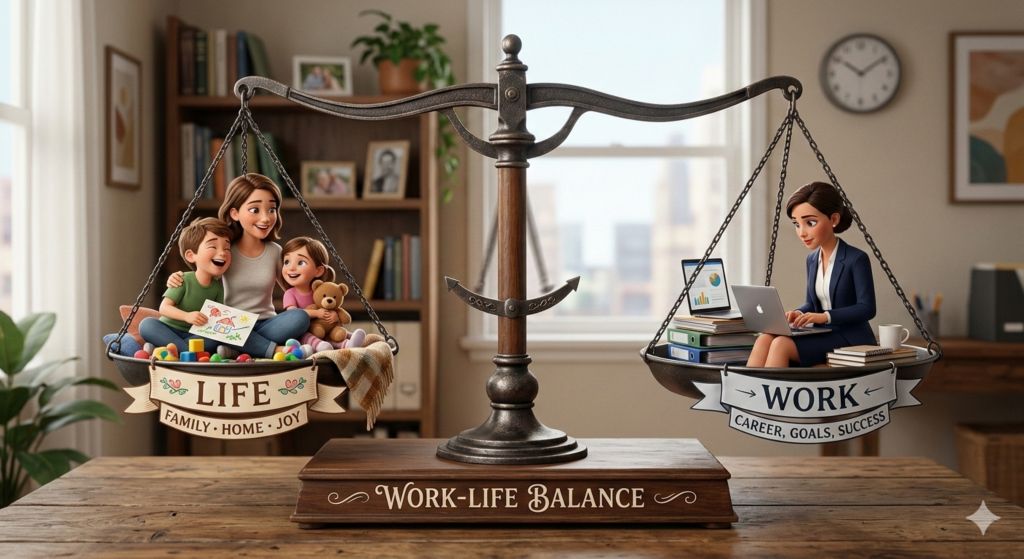
Despite years of slow but steady progress in the field of gender equality, much of the weight of family and home life still falls on women’s shoulders. At the same time, a well-paying career is not just expected of most women, but also increasingly necessary in today’s economic climate, where one-wage families can no longer make ends meet. So, where does this elusive idea of work-life balance come into play and what exactly does it mean in real life?
Balancing act
Work-life balance is generally defined as the ability to maintain equilibrium between the expectations of work and the demands of a personal life, which should ideally include family, friends, hobbies, and other activities that contribute to a well-rounded existence. But as you will see, balance is probably not the right word to describe this constant shifting burden of expectation that people (mostly women) carry through life.
To get a better understanding of this ever-changing challenge, we performed exhaustive desktop research into the global state of work-life balance. But that wasn’t enough. We wanted to understand the deeper human reality behind this topic. So, we spoke to women across roles, industries, and continents, who are working for Volvo Group, and asked them to share their own personal reflections for this article. Their authentic voices and real-world experiences reveal both the complexity of the subject matter and the ongoing pursuit of balance.
When one side suffers, everything suffers
Most of the people we spoke to reported that they experience a ‘mostly balanced’ work-life situation. This was mainly thanks to the available support from the teams in which they work, flexible working arrangements, and taking personal responsibility to prioritize family life whenever necessary. A key element of this is being able to set clear boundaries at work with their immediate manager, and the ability to manage their workload effectively and ask for support when needed. To most of the women we spoke to, work-life balance isn’t a luxury – it's essential to living a full and sustainable life.
Prativa Dhal, a Digital Product Area Owner at Volvo Trucks, puts it plainly: “Without balance, one side eventually suffers – when career overwhelms family or family overwhelms career, both stability and fulfillment are lost.”
For some, this isn’t a theory but a lived daily reality. “Balancing career and family responsibilities isn’t an abstract concept for me,” says Crystal Lienhart, a Material Planning Supervisor. “I’ve learned firsthand that balance isn’t about perfection, but about resilience, flexibility, and support systems.”
“Passion sometimes drives you to compromise the experiences that actually give life meaning… I want to contribute to a world where you do not need to choose between a job you're proud of and thriving family life.”
A challenge still deeply gender rooted
Katherine Scherzberg, Head of Command Center Roll Out in Digital & IT, challenges the concept of work-life balance itself, noting that “society has put enormous amounts of pressure on people” through both well-meaning advice and controlling expectations. Indeed, many women feel the pressure to live up to societal expectations and find it exhausting at times.
Caregiving and family responsibilities
With most women working at least 40 hours per week at their place of employment, they find unpaid caregiving and family responsibilities can take anywhere from 25-50 extra hours per week, leaving precious little opportunity for downtime and leisure activities. This can result in some women needing to work outside of normal working hours to get their paying jobs done. But this burden is not constant. There is an ebb and flow which the women we spoke to highlighted, depending where in either their career or family life they found themselves.
The 35% motherhood penalty
According to a report from Bankrate, called The Motherhood Penalty, full-time working mothers earned 35% less than fathers in 2024 (median earnings: mothers $56,680 vs fathers $76,388).
Put simply, younger women with small children and a career face far greater challenges than women with older children and a more established career. But even then, it isn’t necessarily easier. Older women often take on extra caregiving responsibilities for aging parents or relatives, while others, with special needs children, seldom, if ever, experience what we call work-life balance.
Despite this, over 79% of the women we spoke to at Volvo Group reported that their work-life balance was either ‘very’ or ‘mostly’ balanced, with 21% claiming it to be ‘neutral’ and just 1% ‘somewhat unbalanced’, with the vast majority (75%) feeling little social pressure to ‘stay visible’ at work.
“Career expectations often conflict with family responsibilities, with direct consequences for mental health, well-being, and long-term career sustainability.”
According to the UN Women Data Hub report Forecasting time spent in unpaid care and domestic work, women on average perform 2.8 times more unpaid work than men on care and domestic work.
Others note the weight of traditional expectations. Coming from a culture where women are still expected to manage home and children, Mônica Peres Erbesdobler, Group Manager Thermal Management at Volvo Buses, says, “This can be one of the hardest things for women.”
Our survey at Volvo Group showed that roughly 42% experienced some sort of negative effect in this regard.
“I still managed to get promoted to a leadership position, but my salary was impacted around 10% by the birth of my two children. I took longer maternity leave than my husband because it is more accepted socially, but I got limited salary increase during that time, not reflecting past performance. For every maternity leave break it takes at least another year after to catch up with everything and reach back to a more normal performance level which impacts both salary and the confidence to push for promotion opportunities. In the other ways, it allowed me to defend boundaries about work/life in a much stronger way,” said one respondent, who wished to remain anonymous.
Katherine Scherzberg reflects a similar experience: “I have had two children during my career. I also bear the majority of childcare and homecare responsibilities in my home. While I have been able to professionally develop, continuously learn and grow, I have not been able to travel/spend late in-office hours, and have not been invited to the boy’s table many times throughout my career.”
On the question of leadership roles
Delphine Pauty, a Purchasing Task Force Leader, also reflects on the fear many women carry when considering leadership roles: “Too many women hold back… I felt that same guilt and uncertainty when I became a manager.”
What emerged from our conversations with the women working at Volvo Group was clear: flexible working hours, hybrid work, a supportive leader and team, access to parental leave and the ability to clearly plan their workload makes a huge difference in their everyday lives.
The power of sharing real experiences
Many contributors highlight how valuable it is simply to share honest stories.
Elke Decaluwe, VP Uptime Center at Volvo Trucks believes in “sharing real life experiences to learn from one another.”
Archana Nair, an experienced Project Manager adds, “Not everyone has it perfect… sometimes I get really good tips or a perspective I never thought of.”
For those who have struggled, the desire to help others is strong.
“I struggled myself in this journey,” says Majken Olsson, Head of Engineering & Advisory Services Purchasing, “perhaps my experience can help others on the way.”
These shared experiences don’t just inform – they comfort, reassure, and inspire.
Redefining balance
Many contributors emphasize that balance is not a fixed state. It's adaptive.
Mathilde Fallet, Project & Portfolio Manager, frames it clearly: “To be good in your career you need to have quality personal and family time.”
"When you are doing well at work, it positively affects your family life.”
Others speak of the emotional relief of finding solutions – imperfect as they may be. “It means not feeling like both a bad mother and a bad professional,” says Camilla Ridolfi a HSEQ Manager at Volvo Trucks.
For some, the importance is shaped by experience: “I spent too many years without balance and I hope to help others avoid some of the pitfalls I experienced,” said one Volvo Group employee who wished to remain anonymous.
Why work–life balance matters for organizations
The topic isn’t just personal; it’s foundational to organizational health.
A 2025 “state of the workplace” report from Deloitte, found that 31% of employees who quit in 2024 cited burnout or lack of work–life balance as a primary reason, and 37% left due to poor engagement or toxic culture.
Maryline Godard at Volvo Group highlights the broader impact: “A better work–life balance helps reduce stress, improve employee engagement, and fosters a more inclusive and productive work environment.”
The message is clear: when employees thrive, companies thrive.
Toward a more sustainable, human work culture
Across experiences, cultures, and professional backgrounds, one message resonates: balance is both necessary and possible – but only when individuals and organizations work together to make it real.
Whether through shared stories, structural change, or reshaping cultural expectations, the path forward is collective. And as these women show, speaking openly is one of the most important steps in bringing about a more balanced approach to life and work.
Tips to achieve that balancing act
Achieving a healthy work-life balance requires a fundamental shift in perspective: recognizing that while you are replaceable at work, you are indispensable at home. To protect your well-being, you must establish clear boundaries, treat physical and mental health as non-negotiable appointments, and prioritize long-term family milestones over fleeting professional demands. Success in this area involves ruthless prioritization—learning to say "no," delegating tasks, and utilizing structured routines to maximize focus. Ultimately, by choosing supportive environments and decoupling your self-worth from workplace perfectionism, you can view your career as a resource that supports your life rather than a source that consumes it.